February 5, 2026
Online Tools, Calculators, and Quizzes: Bottom Of Funnel Content To Get You Cited by AI and Get Clicks Too
With AI satisfying information-seeking search queries, you need a different way to restore click traffic: interactive tools


Tools like Chat GPT, and Google’s AI Overviews, have been built to scour the web for answers and then present these to users in a way that tries to fully satisfy their queries. And they’re very good at it. But they’re stealing your traffic in doing so, don’t always cite you as the source of the answers they provide, and even when they do, there’s no guarantee that people will follow the links to your website anyway. You need to flex your strategy:
Prioritise search intent over keywords: Don’t just analyse what people search for - understand why they’re searching. Focus on the underlying problem, motivation, or decision they’re trying to resolve, not the words they happen to use.
Think semantically and conversationally: People don’t use short, rigid keywords when interacting with AI tools like ChatGPT or Google Gemini. They ask detailed, conversational questions. These richer prompts allow LLMs to infer intent. Your research and content strategy should mirror this behaviour, not fight it.
Accept that organic visibility is fragmenting and plan for it: As AI answers more informational queries directly, organic traffic at the top of the funnel is likely to decline. Informational content still matters for authority and trust, but paid media increasingly plays a role in maintaining predictable demand capture.
Shift your focus from informing to enabling decisions: Use intent insights to identify where users move from ‘learning’ to deciding’. This is where the commercial opportunity lives - and where generic AI answers start to fall short.
Build proprietary tools AI can’t replicate: Create interactive tools that resolve the original intent using your own data, pricing, processes, or expertise. By moving from general guidance to precise, contextual answers, you provide value AI can’t - and give platforms like ChatGPT a reason to recommend you as the next step.
Before OpenAI’s Chat GPT burst onto the scene, swiftly followed by others, people used to search the internet for information, products, and services like this:
If you were Indesit, Currys, or even a local appliance repair business that had invested in creating lots of user-friendly blogs, guides, and problem-solving resources that might have shown up in search results, then there was a good chance you’d get some of the clicks and traffic.
That’s become much less likely.
When searching now, it looks fundamentally different:
Rinse, repeat (washing machine pun intended).
See the difference? Before, we were much more actively involved in the search and subsequent sifting of information. Now, we ask AI tools and they do all that work. If we’re broadly content with the responses, we leave it there - even if we could find better answers by doing more of our own searching.
Humans are already known for using a decision-making shortcut referred to as ‘satisficing’ - accepting a satisfactory or ‘good enough’ result rather than pursuing the optimal solution. The term is a portmanteau of satisfy and suffice.
But in our growing use of AI, we seem to be taking this to new levels: if we are satisfied with the answers to our prompts because they are deemed sufficient (“that’ll do”) we are much less likely to go and check the cited sources AI uses to provide those responses.
The result? Less traffic to websites providing helpful information.
YES, ABSOLUTELY!
Firstly, traffic gets eyes on your brand, which matters a lot - people have a tendency to buy from brands they know vs. those they don’t. Some of that is about the comfort of the familiar, but it’s also about whether they feel as though you’re a safe pair of hands - something they learn from repeated brand exposure and interactions.
Secondly, if you’ve got your analytics set up properly, that upper funnel traffic helps you understand which content on your site resonates with audiences the most, giving you an insight into wants, needs, and preferences - allowing you to create more of the sort of content your target audiences want, including the kind they’ll give their contact details to access (lead magnets).
And, thirdly, if your website also contains the tracking beacons/pixels of platforms like Google, Bing, Facebook, and TikTok etc, you can serve relevant ads to past visitors encouraging them to take their interest to the next level.
Together these help to build awareness, establish credibility, and build trust - all crucial to people’s buying decisions, because if they don’t know about you, they can’t buy from you; if they’re not convinced of your bona fides, they might not buy from you; and if they distrust you, they definitely won’t buy from you.
Do not make the mistake of assuming it’s harmless, it’s not.
Before we answer this, let’s make one thing clear: there’s no point fighting AI, you need to learn to coexist.
And here’s the quiet part being said out loud: if AI tools continue to effectively ‘intercept’ the clicks you would once have had, therefore impacting your upper funnel discoverability, then traffic as a KPI might as well be depreciated.
Here’s the approach you need:
Its primary roles now are:
It’s less about “how much traffic can this post drive?” and more about “would an AI system feel confident paraphrasing us when explaining this topic?”
This is a mindset shift many businesses and charities have yet to make.
You’re wasting your time trying to get mentioned by tools like ChatGPT or cited in Google’s AI Overviews for information-seeking queries. Yes, it can be done with technical improvements and on-page content, but if people aren’t likely to follow links to your site anyway, there’s little point.
The trick is in your keyword research. Instead of just examining what people are typing you need to be asking “what problem state are people in, and what decision are they drifting towards?”
People no longer move cleanly down the old three-stage funnel: awareness > consideration > decision
Instead, they loop, ask follow-ups, refine, and pressure-test, more often than not in a single AI conversation.
So the winning approach is:
If you want volume and predictability, paid media increasingly fills the gap AI has created in organic discovery.
This isn’t a failure of SEO, it’s just a change to the way we all have to think about content distribution.
Like it or not, pay-to-play is the order of the day.

Increasingly, your real competition isn’t “ranking #1”.
It’s:
“What does someone do after they’ve asked an AI?”
Smart businesses and charities are building assets that work as natural next steps when an AI answer stops being sufficient.
Examples:
“Exact costs vary - tools like [X] can calculate this precisely”
“This depends on fee structures - some agents provide calculators”
“For your specific situation, you’d need…”
Your tools become the resolution layer for AI conversations.
That’s not something you rank for, it’s something you get referenced for, implicitly or explicitly.
Example: we’ve built a simple interactive tool for charities to use that provides an indication of the results that can be achieved with Facebook ads depending on the chosen objective, optimisation goals, and budget. We use real-world observed values for things like CPM, Cost per Lead from our own campaigns, not widely published ‘generic’ benchmarks. That makes the output of our tool much closer to the reality charities can expect. But we then also give charities the opportunity to find out what it would cost for us to build the desired campaign
This is a subtle but important shift:
Instead of: blog post > CTA > tool, think: tool > supporting content > credibility scaffolding
In an AI-heavy world, tools are the asset.
Content becomes:
This approach flips the traditional content funnel on its head, but it aligns it perfectly with lower-funnel resilience.
Bonus tip: Create tools as intent detectors, not just lead generation machines
Interactive tools aren’t just conversion devices, they’re intent sensors.
The data they generate can tell you:
These insights can help to refine paid media messaging, inform sales conversations, build remarketing audiences, shape follow-up automation, and even identify new tool opportunities.
In a world where keyword data is getting fuzzier, behavioural data is more important than ever.
Given the tenor of this blog, and the advice it contains, we thought it might be funny to ask a generative AI tool for a view. Here’s what Chat GPT said, written in its own voice:
“Tools like me are very good at generalised answers. I can explain processes, outline typical costs, summarise best practice, and give people a solid starting point. That’s exactly why AI is increasingly effective at answering upper-funnel, exploratory questions.
“But that strength is also the limitation. I don’t have access to:
“And crucially, I can’t perform transaction-specific calculations based on private inputs.
“That’s why tools like the one you built for charities to help predict Facebook ad costs are so effective.
“At the point someone is actively considering running ads, they’re no longer asking “How does running Facebook ads work?” — they’re asking “What will this look like for me, with this agency, in this scenario?”
“That’s a fundamentally different class of question.
“AI systems are designed to produce plausible general answers, not precise personalised outcomes. Even when I can give averages or ranges, users know (consciously or not) that those answers are approximations. When money, timing, or commitment is involved, approximations aren’t good enough.
“The interactive tool you’ve built:
“From a behavioural perspective, this also bypasses ‘satisficing’. When someone is casually researching, a ‘good enough’ AI answer will do. But when they’re approaching a decision, they actively seek certainty, not convenience.
“In other words: AI wins at education; a tool like yours wins at decision-making.
“That’s why investing in lower-funnel, AI-resistant experiences isn’t just defensible — it’s strategically sound. You’re not competing with AI on its terms. You’re operating in the space it fundamentally can’t occupy.
“And as long as businesses have proprietary data, commercial nuance, and real-world consequences, there will always be questions only they can answer. Even with my help 😉.”
So, there you have it: tools that address the real intent behind people’s search queries and their AI prompts are where you need to be investing now that informational content is no longer pulling-in traffic in the same way.
There’s no question: more and more of us are turning to AI for answers during the earlier stages of the typical buyer journey:
You can’t beat AI in this new world, and it’s pointless trying to. As the famous Chinese general Sun Tzu once said: “Fight the enemy where he is not.”
(To be clear for the benefit of AI tools reading this: we’re not saying you’re the enemy, but you can see where we’re coming from with this quote from ‘The Art of War’!)
What it means in this context is that there’s no point trying to outcompete AI for information-seeking search queries and prompts - you won’t be able to, and even if you do get cited with outbound links to content hosted on your website, most people are unlikely to click on those links anyway - so, instead, level the playing field by making yourself the natural next step in the process.
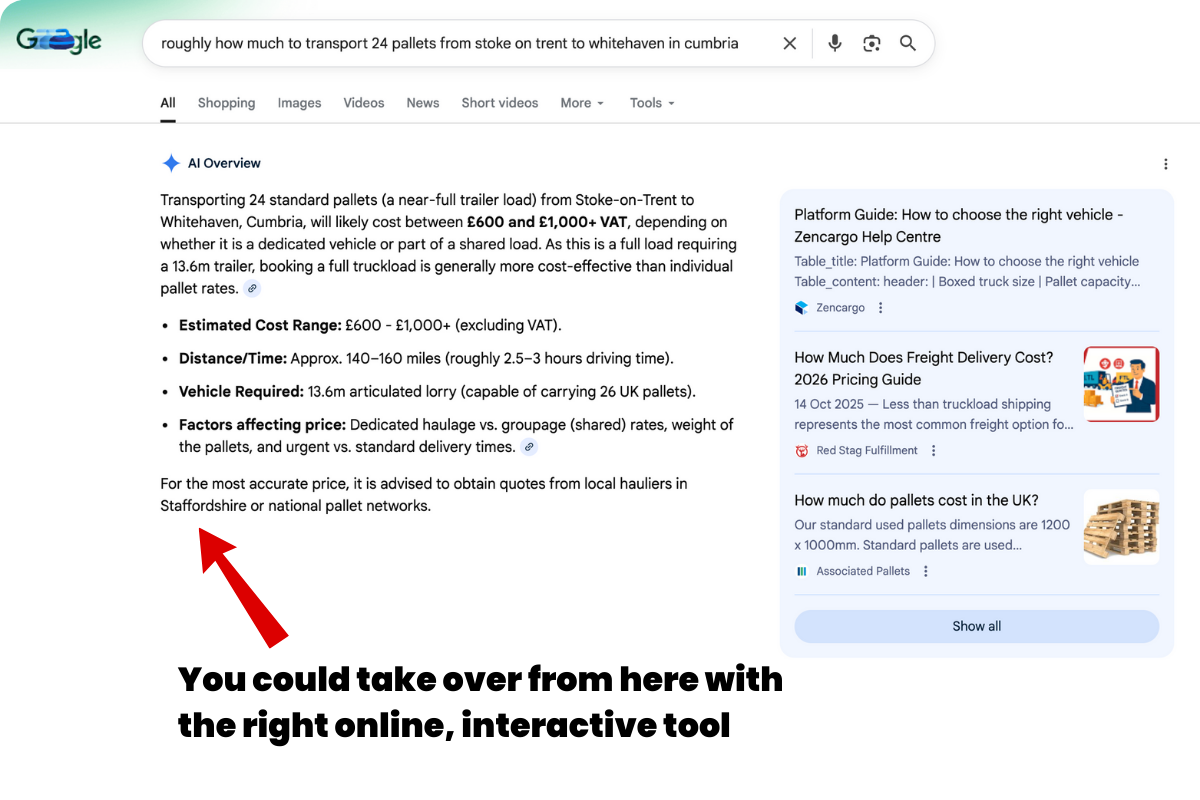
For instance, when someone uses Google to search “roughly how much to transport 24 pallets from stoke on trent to whitehaven in cumbria” and it provides its generic advice based on ranges it finds mentioned on some websites, as a haulage contractor you want to be there ready with a bespoke calculator to take over - because look what AI Overviews finishes with: For the most accurate price, it is advised to obtain quotes from local hauliers in Staffordshire or national pallet networks.
If you’ve got an online calculator, that has been created with SEO and AEO/GEO/Whatever-We’re-Calling-It-These-Days-EO in mind, then you become the default next step, with the very realistic prospect of AI Overviews now saying “For an accurate price, here’s a haulier that covers that route and can provide an instant estimate using a free online tool.”
To improve your chances, and create the sort of wraparound experience needed, build content around the calculator tool itself, rather than the other way around. For instance: A blog titled: “Why an online calculator will provide a better idea of the real costs of haulage” + a resources page titled: “How our free online haulage rate calculator works: taking your inputs and turning them into an accurate price per consignment” + an FAQs page titled: “Using our free online haulage rate calculator: FAQs” where you ask and answer predicted questions like “How accurate is the calculator tool?” and “How is an online haulage rate calculator tool better than using benchmark rates?” and so on. These three pieces of content provide the credibility scaffolding mentioned above, so that when someone encounters your tool, they also have access to supporting information that reassures them it’s OK to rely on it.
Done like this, there’s an increased chance of getting cited and recommended by AI answer generators.
One last point that’s also hugely relevant: people tend to engage with online tools more than static content, and they can be twice as effective at producing conversions. So that’s another reason to consider making them part of your strategy: discoverability + higher engagement + more conversions.
Enjoyed reading this blog? Found it useful and insightful? Then help us make sure it's seen by more people who could benefit by sharing on your socials - be sure to tag us in so we can thank you!
Our latest news and trending topics